Head banging is hardly a new phenomenon

March 24th, 2007

It seems that head banging is nothing new on the island of Tenerife.

Long before holiday revellers brought head banging from the London clubs to the nightspots of Playa de las Americas, Tenerife had its own variation of the phenomenon

A study of the skulls of the island’s original inhabitants by scientists at the Canarian Institute of Palaeopathology and Bioanthropology in Santa Cruz found that fractures were common among males in their 20s and early 30s, according to the Journal of Paleopathology.

The scientists examined over 400 skulls pre-dating the Spanish invasion of the island in 1496.

Some 10 per cent of the skulls showed circular cranial fractures, an injury rarely found among archaeological human skeletons.

The pre-Hispanic inhabitants of the island, the Guanches, had weapons similar to the Argentinean bolas – two or more heavy balls attached to a cord.

Over 80 per cent of the fractures show clear signs of healing, says the report, though the scientists suspects that brain damage must have resulted from the injuries.


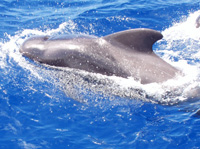
Sanctuary for whales and dolphins

March 23rd, 2007

The government of the Canary Islands wants the seas off the west coast of Africa to be declared a sanctuary for cetaceans, the order of mammals to which dolphins and whales belong.

They would like to see the protected area cover all of the Macaronesia islands – the collective name for the five volcanic archipelagos of the Azores, Madeira and Salvages (Portuguese), the Canaries (Spanish) and Cape Verde (independent).

The proposal will be discussed at an International Conference for the Protection of Dolphins in Tenerife in November.

The Dolphin ExcursionThe conference is one of a series of worldwide events being held to mark the International Year of Dolphins, with representatives attending from Spain, Portugal and African countries.
The dolphin campaign is an initiative of UNESCO, the United Nations Educational, Scientific and Cultural Organisation.

It has the enthusiastic backing of the Loro Parque Foundation in Puerto de la Cruz, Tenerife, which has launched a range of events aimed at raising the interest of school children in whale-watching trips and scientific research into marine mammals, and to motivate students to support conservation and protection.

The President of the Loro Parque Foundation, Wolfgang Kiessling, is backing the Canarian government call, emphasising the need for a large protected area in the Atlantic Ocean to ensure the survival of dolphins and small marine mammals.

Ahead of the November conference, the Canarian government is consulting various interest groups such as boat owners, tourist operators, protection groups and environmental organisations on this and other conservation activities.


Street arts festival crams in a lot

March 22nd, 2007

The Arts FestivalMUECA 2007 kicks off tomorrow (Friday March 23), bringing another dimension to the cultural diversity of Puerto de la Cruz in the north of Tenerife.

The International Street Arts Festival, now in its third year, takes place in the central streets, squares and around the harbour of Puerto, with a staggering 73 performances lined up over the three days. Entry to most of the activities is free.

Last year the festival drew an estimated 15,000 visitors to the town.

This event is a cultural showcase for Canarian innovation in comedy, theatre, dancing, music, photography, painting.

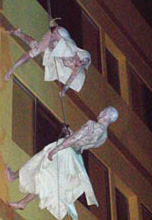
Arts from a houseThese include shows such as a vertical dance group, who perform on the sides of buildings; a theatre company who out their audiences in boats to tell them stories about sailors and fishermen; a story kitchen where tales are told to the accompaniment of the flavours and aromas they feature; and a competition for human statues.
The first event, body painting, starts at 6pm on Friday and various other activities follow across the town until well after midnight.

On Saturday, the day’s programme starts at 11am and again continues beyond the witching hour.

Sunday’s activities start at 10am and festival draws to a close around lunchtime


Tiger, tiger burning bright…

March 21st, 2007

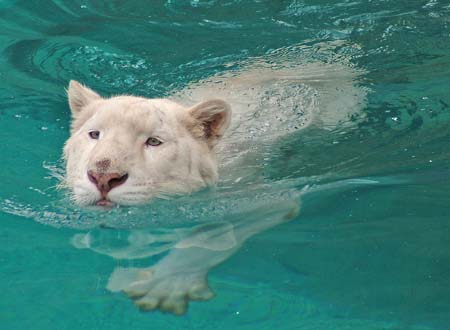
White tiger swimming

It’s a common misconception that cats hate swimming in particular and water in general.

My experience of the domestic moggy is strictly limited, but I’ve watched Prince, one of the star attractions at Loro Parque, Tenerife’s biggest tourist attraction, enjoying a dip in his private pool on several occasions. He loves it.

Indeed, tigers love water, and white tigers particularly adore it. White tigers have the reputation of being good swimmers but poor climbers.

Which is strange really because the white tiger is not a sub-species as such, but rather a genetic misfit.

White tigers are rarely found in the wild. In about 100 years only 12 white tigers have been seen in the wild in India.

They are almost extinct and most of the ones living are in captivity, mostly in zoos, though rarely are they as well catered for as at Loro Parque.

The white tiger is neither an albino nor a separate sub-species of the tiger, but simply has the rogue gene needed for white colouring.

None of which concerns Prince as he takes his daily dip before stretching out regally in the sun as his many admirers pay homage.

White tiger


Los Rodeos on the up and up

March 20th, 2007

Tenerife’s lesser-know Los Rodeos airport in the north of the island is undergoing a facelift.

Los Rodeos is only six miles from the Tenerife capital of Santa Cruz and 12 miles from the popular resort of Puerto de la Cruz and the historic 500-year-old town of La Orotava.

A new VIP lounge opened recently, part of an ongoing programme of improvements soon to include a new transit lounge, new ticket sales desks and the expansion of domestic and international arrivals areas.

Despite being the first airport to open in Tenerife way back in 1930, Los Rodeos was forced to take a back seat as far as tourism was concerned when Reina Sofia airport opened in the south of the island in 1978.

But after a sharp increase in passenger numbers during the 1990s, Los Rodeos underwent substantial modernisation between 2002 and 2005, with a new car park, motorway access ramps, a new four-storey passenger terminal with 12 gates a separate terminal for inter-island flights.

As well as offering domestic and international connections, Los Rodeos has become an important inter-island hub, connecting with all six of the other islands in the Canaries archipelago.

Last year the airport handled over four million passengers.

New services from the British Isles include BA’s Gatwick flights, operated by its GB Airways subsidiary, Ryanair’s from Dublin and winter charter flights from Gatwick and Manchester operated by Britannia Airways.