Exchanging a glance with a gorilla

March 19th, 2007
dscf7881.jpg

‘There is more meaning and mutual understanding in exchanging a glance with a gorilla than any other animal I know.’

An estimated 500 million people worldwide heard Sir David Attenborough whisper those words as he lay next to a 100kg female gorilla in Rwanda nearly 30 years ago.

His encounter with the gorillas in the BBC natural history series Life on Earth is one of television’s most memorable.

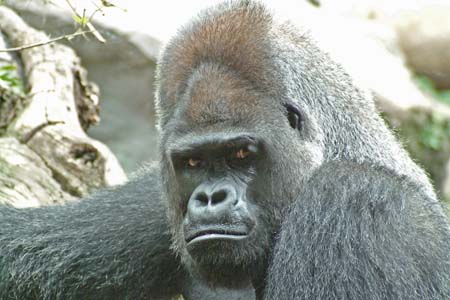
At Loro Parque in Tenerife, you can’t get quite as close to the gorillas as David Attenborough did all those years ago.

But, as the pictures above and below show, you do get a pretty good view of the park’s gorilla enclosure, which covers 3,500 square metres and houses six gorillas in conditions very like their native habitat.

The six gorillas are part of an experimental group on loan from various European zoos and form part of a breeding programme for endangered species.

Situated in Puerto de la Cruz in the north of the island, Loro Parque is rightly recognised as one of the finest animal parks anywhere in the world.

The gorillas are fed only the best fruit and vegetables and their living quarters have constant ventilation and under-floor heating to provide perfect conditions for them.

Incidentally, the BBC4 will be broadcasting on Easter Sunday a programme entitled ‘Gorillas Revisited with David Attenborough’, in which he tells the story of how he and his film crew managed to obtain such excellent pictures of the Rwanda gorillas.

dscf7878.jpg


Orchestra taking the trail to Texas

March 18th, 2007

The Tenerife Symphony Orchestra is to tour Texas in the summer as part of a series of cultural exchanges between the Canary Islands and the Lone Star state.

The tour will begin in Houston, Texas’s largest city, on June 28, moving on to historic San Antonio – scene of the famous Battle of the Alamo in 1836 – on June 30.

San Antonio, now a city of over a million people, was founded in 1718 by settlers from the Canary Islands.

Further concerts are scheduled for Fort Worth on July 2, Laredo on July 4 and Corpus Christi on July 6.

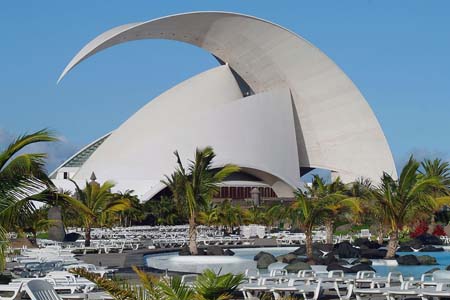
Auditorio de Tenerife•The Auditorio de Tenerife, home of the Tenerife Symphony Orchestra.
Over 100 musicians and technicians will make the journey from Tenerife for a programme of music that will be typically Spanish in flavour, featuring zarzuela, or light opera, and works by Granados and Falla.

The orchestra will be conducted by Edmon Colomer, while the soloist will be Tenerife soprano Raquel Lojendio.

The Orquesta Sinfonica de Tenerife (OST) has a long history, dating back to its formation as the Chamber Orchestra of the Canaries in 1935.

The orchestra is no stranger to touring, having appeared in all of the major cities on the Spanish mainland and featured regularly in music festivals across Europe.

The OST is based in the island capital of Santa Cruz, at the city’s recently-opened magnificent concert hall, the Auditorio de Tenerife.


Just another Tenerife sunset

March 17th, 2007

Sunset at La Paz

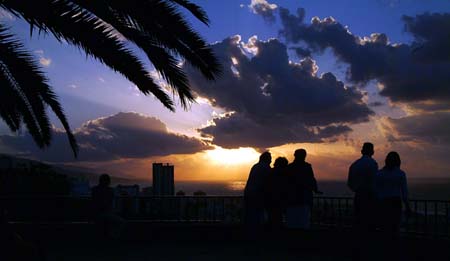
Sunsets over Tenerife can be pretty spectacular, as this shot taken from the mirador at La Paz, Puerto de la Cruz, clearly demonstrates.

The scientific explanation for the vivid colours we see as the sun goes down revolves around the low angle scattering of light off fine particles of dust, soot, smoke and ash.

One of the reasons sunsets over Tenerife can be so special is the island’s relative proximity to the Sahara Desert.

For most of us, their sheer beauty is intoxicating enough not to require further explanation.


Santa Cruz bids to be European Capital of Culture

March 16th, 2007

Spain has been designated to provide the European Capital of Culture in 2016 and already a dozen cities, including the Tenerife capital of Santa Cruz, are lining up to compete for the glittering prize.

Also battling for the coveted nomination will be the mainland cities of Cordoba, Cuenca, Cáceres, Burgos, Tarragona, Pamplona, Zaragoza, Segovia, Valencia and Alcalá de Henares.

And while Santa Cruz may not have some of the glamour of its peninsula rivals, it need not feel inferior in any way.

The stunning Auditorio rivals any concert hall anywhere in Spain for sheer architectural magnificence, while the annual carnival is hugely popular both locally and internationally.

The Auditorium from Santa CruzIt also has in its environs the World Heritage Site of La Laguna and the sheer natural beauty of the Anaga Mountains.

The European Capital of Culture is designated by the European Union for a period of one year during which the city has a chance to showcase its cultural life and development.

A number of European cities have used the City of Culture year to transform their cultural base and, in doing so, the way in which they are viewed internationally.

Conceived as a means of bringing citizens of the EU closer together, it was launched in 1985 and was the brainchild of the Greek Minister of Culture Melina Mercouri.

Since then, the initiative has become more and more successful, having an increasing cultural, social and economic impact on the chosen cities.

Three Spanish cities have so far been honoured – Madrid in 1992, Santiago de Compostela in 2000 and Salamanca in 2002.

Glasgow is thus far the only UK city to be honoured, though Liverpool takes the accolade in 2008.


The Great Tenerife Fireball

March 15th, 2007

It happened nearly 12 years ago but people still recall it today – the Great Tenerife Fireball of 1995.

Thousands saw it, mostly in the east and north of the island, describing a brilliant fireball that flashed across the night sky shortly after 10pm.

It happened on Sunday May 7 and hundreds of people called the Canarian Institute of Astrophysics (IAC) seeking an explanation of the phenomenon.

Because it happened at a weekend there were many witnesses to the unusual event. Sunday had been a fine day on Tenerife and many people were returning to their homes from a day at the beach, in the mountains or with friends and family.

From the many hundreds of eye witness accounts, scientists were able to paint what they believe to be a fairly accurate picture of what happened.

It was around 10.30pm that radio stations on the island broke into their normal programmes to broadcast calls from witnesses who told of having seen a huge light in the sky.

Some said it had the appearance of a meteor but was much brighter, others feared it might have an aircraft crashing in flames.

That latter theory was quickly discounted by aviation authorities, confirming that no aircraft were unaccounted for. The object had not registered on air traffic control, military radar or on any of the many reconnaissance satellites that girdle the earth.

Many witnesses said it had been visible for around five seconds and looked like a comet with a long tail, others that a bright flash of light was seen as it disappeared.

A family in Tegueste reported that the final flash of light was so bright it lit up the inside of their home. An amateur astronomer in Santa Cruz reported hearing a noise, while others spoke of hearing a dull rumble in the distance.

In Puerto de la Cruz, two observers described the light as disappearing to the north. Some spoke of seeing Mount Teide lit up briefly, while in La Laguna reports described watching it disappear over the Anaga Mountains.

After studying the many reports from Tenerife and adding those from eye witnesses in the neighbouring islands of Gran Canaria and La Palma, IAC scientists concluded that it had indeed been a meteor and furthermore they had been able to plot quite accurately its progress across the night sky.

So sure were they of their findings that they were able to say with firm conviction that the meteorite had weighed around half a kilogram, that it had passed over the Atlantic Ocean, had started to burn up between the islands of Gran Canaria and Fuertaventura and travelled north west before exploding and falling into the ocean some 75 miles north of Tenerife.

Any surviving fragments might have yielded further information but they were well out of reach on the ocean floor at a depth of 3,000 metres.